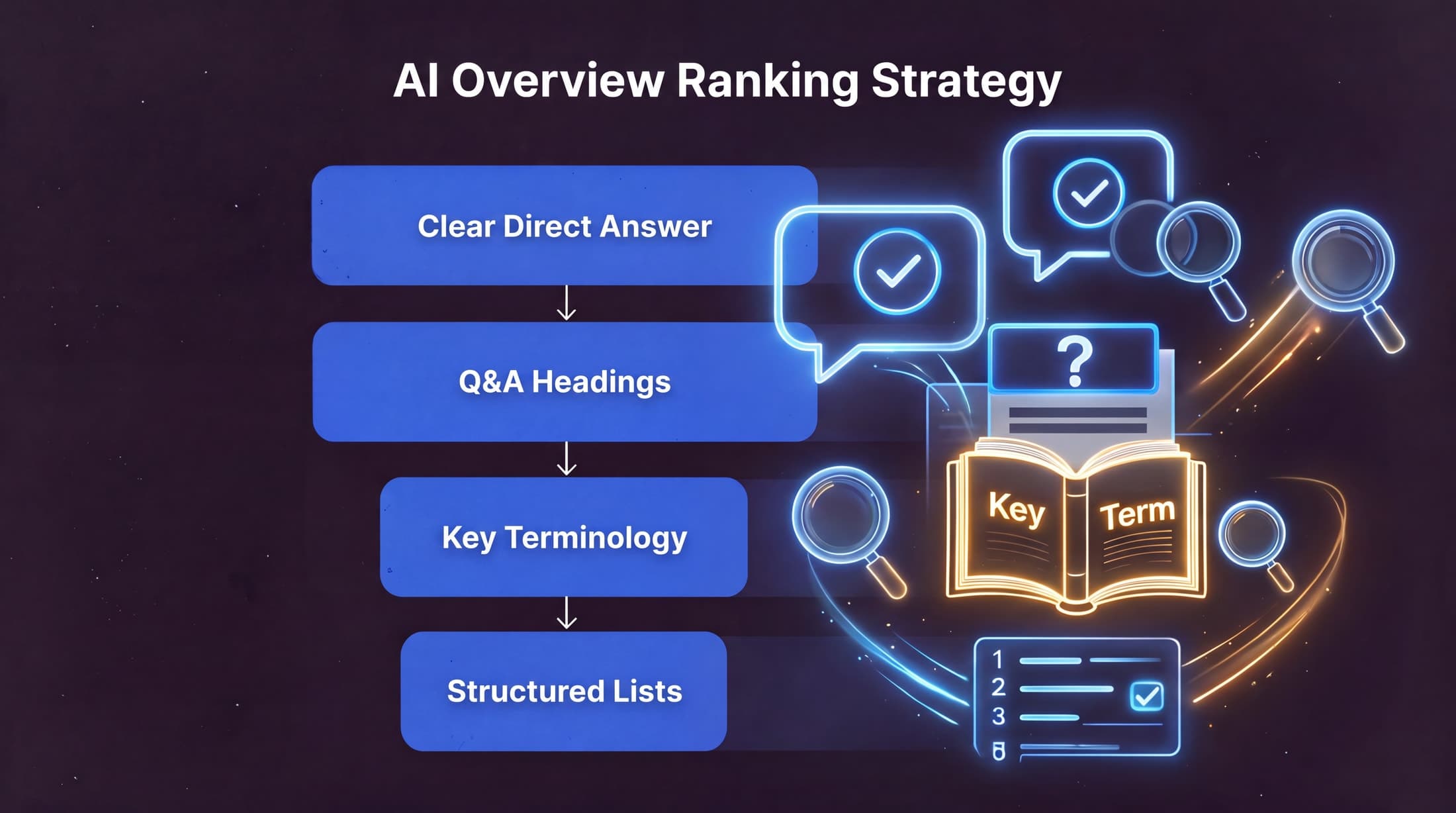
To rank in AI Overviews, structure your content to answer questions directly in the first paragraph, use clear headings phrased as questions, define key terms plainly, and organize information in lists and tables. Google's AI prioritizes content that can be quoted accurately and understood immediately, so front-load answers and eliminate fluff.
What are AI Overviews and why do they matter for SEO?
AI Overviews are Google's AI-generated answer boxes that appear at the top of search results, synthesizing information from multiple sources to answer user queries directly. They matter because they occupy the most valuable real estate in search—above traditional organic results—and can either drive qualified traffic to your site or make it invisible. When your content is cited in an AI Overview, you gain authority and clicks; when it's not, you lose visibility even if you rank on page one.
For small business marketing leaders, this shift is urgent. Traditional SEO focused on ranking URLs. The new reality requires optimizing for answer extraction—what we call AEO (Answer Engine Optimization). Your content must be structured so AI can confidently quote it, attribute it, and trust it.
How is AEO different from traditional SEO?
AEO prioritizes answer quality and structure over keyword density and backlinks. Traditional SEO asks, "How do I rank this page?" AEO asks, "How do I make this content quotable by an AI?"
Key differences:
SEO rewards comprehensive content, internal linking, and domain authority
AEO rewards direct answers, clear definitions, and scannable formatting
SEO optimizes for human readers clicking through from a results page
AEO optimizes for AI systems extracting and synthesizing information
You need both. SEO gets you into the consideration set; AEO gets you cited in the Overview.
What are the ranking factors for Google AI Overviews?
Google's AI selects content for Overviews based on clarity, structure, authority, and relevance. While the exact algorithm isn't public, patterns are clear from analyzing thousands of featured answers.
Primary ranking factors:
Direct answer placement — The first 40-60 words answer the core question without preamble
Question-based headings — Subheadings match natural language queries ("How long does X take?" not "X Duration")
Structured data — Lists, tables, and definitions that AI can parse cleanly
Plain definitions — Key terms defined in one sentence ("X is...")
Source credibility — Domain authority, author expertise, and factual accuracy
Content freshness — Recently published or updated content gets priority for time-sensitive topics
Think of it this way: if an AI assistant had to quote one paragraph from your page to answer a user's question, would it know which paragraph to choose? If the answer isn't obvious, restructure.
How do I structure content to rank in AI search engines?
Start every piece with a direct answer, then expand with supporting detail. Use the inverted pyramid journalists rely on: most important information first, context second, background third.
Step-by-step AEO structure:
Open with a 40-60 word direct answer that stands alone when quoted
Use ## headings phrased as questions your audience actually asks
Answer each heading in the first 1-2 sentences of that section
Define key terms plainly the first time they appear ("AEO is...")
Use numbered lists for steps, bulleted lists for options, tables for comparisons
Keep paragraphs short (2-4 sentences) for scannability
End with an FAQ section answering 3-5 follow-up questions
This structure works because it mirrors how AI systems parse and extract information. You're making the AI's job easier, which increases your odds of citation.
What content formats perform best in AI Overviews?
Lists, tables, and step-by-step guides dominate AI Overview citations because they're unambiguous and easy to extract.
FormatBest ForExample Use CaseNumbered listsSequential steps, ranked items"5 steps to optimize for AEO"Bulleted listsParallel options, features"Benefits of AI search optimization"TablesComparing 3+ items across attributes"SEO vs AEO: key differences"DefinitionsExplaining terminology"What is Answer Engine Optimization?"FAQ sectionsAddressing common follow-up questions"How long does AEO take to show results?"
Avoid long paragraphs, vague introductions, and burying answers mid-page. AI systems time out or move on when they can't quickly locate the relevant information.
How can small businesses compete in AI search without a big team?
You don't need a content factory—you need strategic automation. Small teams win in AI search by focusing on quality over volume and using tools that handle execution while you focus on strategy.
Practical approach for lean teams:
Audit existing content — Identify your top 10 pages by traffic and restructure them with AEO principles (direct answers, question headings, lists)
Target question-based keywords — Use tools to find "how to," "what is," and "why does" queries in your niche
Publish consistently — Two well-structured posts per month outperform ten generic ones
Automate where possible — Platforms like Friday Force handle content generation, SEO optimization, and multi-channel distribution so you're not choosing between strategy and execution
The advantage of AI-powered marketing platforms is they apply AEO structure automatically. Our AI agents—Elena, Omar, Jasmine, Luis, Priya, and Daniel—work together to research audiences, generate optimized content, and distribute it across channels while you sleep. That's not marketing fluff; it's how the platform operates 24/7 without human intervention.
What mistakes should I avoid when optimizing for AI Overviews?
The biggest mistake is writing for humans and hoping AI figures it out. The second biggest is keyword stuffing or manipulating structure in ways that hurt readability.
Common AEO mistakes:
Burying the answer — Starting with a story, anecdote, or "in this post" preamble instead of the direct answer
Vague headings — Using "Overview" or "Introduction" instead of specific questions
Walls of text — Long paragraphs that AI systems can't parse cleanly
Invented data — Fabricating statistics, case studies, or customer quotes (AI systems detect and penalize this)
Ignoring freshness — Publishing once and never updating, even as information changes
Over-optimization — Repeating keywords unnaturally or structuring content only for bots, not humans
Remember: AI Overviews exist to serve users. If your content genuinely answers questions clearly and honestly, you're already ahead of most competitors.
How do I measure success in AI search optimization?
Track whether your content is being cited in AI Overviews, not just whether it ranks. Traditional metrics like "position 3" matter less when position zero (the Overview) captures most clicks.
Key metrics to monitor:
AI Overview citations — Manual checks for target keywords to see if your content appears
Click-through rate (CTR) — Higher CTR from the same position indicates your snippet is compelling
Time on page — Users arriving from AI Overviews should stay longer because they're pre-qualified
Conversions from organic search — Track whether AI-sourced traffic converts at higher rates
Keyword rankings for question queries — Monitor "how to," "what is," "why does" variations
If you're not currently tracking these, start with a simple spreadsheet. Check your top 10 target keywords weekly to see if you're appearing in Overviews. Adjust structure based on what works.
Ready to rank in AI search without adding headcount?
Optimizing for AI Overviews isn't optional anymore—it's how your prospects find answers in 2026. But executing AEO strategy on top of everything else you're managing isn't realistic for lean teams.
Friday Force handles the entire cycle: audience research, content strategy, SEO-optimized writing, and multi-channel distribution. Our six AI agents work together 24/7 to keep your marketing running while you focus on closing deals and serving customers. No learning curve, no additional hires, no choosing between strategy and execution.
Want to see how it works for your business? Call us at 255-9476415 or visit Friday Force to start a conversation with Elena, our AI Marketing Manager. She'll walk you through exactly how we'd approach your specific market and goals.
Frequently asked questions
How long does it take to rank in AI Overviews?
Most sites see initial citations within 4-8 weeks of restructuring content with AEO principles, assuming the domain already has some authority. Brand new sites may take 3-6 months. Consistency matters more than speed—publishing two well-structured posts monthly outperforms sporadic bursts.
Do I need to rewrite all my existing content for AEO?
No. Start with your top 10 pages by traffic. Add a direct answer to the first paragraph, convert headings to questions, and add an FAQ section. That covers 80% of the impact. Rewrite lower-priority pages only as you have time or as they become strategically important.
Can I rank in AI Overviews and traditional search results simultaneously?
Yes. AEO structure improves traditional SEO performance because it increases dwell time, reduces bounce rate, and earns more backlinks. You're not choosing one or the other—you're making your content work harder in both contexts.
What if my competitors aren't doing AEO yet?
That's your window. Early adopters in any niche gain disproportionate visibility because AI systems have fewer well-structured sources to choose from. Once your content is cited consistently, it builds authority that's harder for late movers to displace.
Is AEO only for Google, or does it work for ChatGPT and other AI assistants?
AEO principles apply across all AI systems that extract and synthesize information—Google AI Overviews, ChatGPT, Perplexity, Bing Chat, and future tools we haven't seen yet. The core logic is the same: clear structure, direct answers, and scannable formatting make your content quotable regardless of the platform.