For the last two years, "AI for marketing" has mostly meant one thing: generate me a piece of content. A caption. A headline. An image. The marketer stayed in the same role they'd always been in — assembling, sequencing, scheduling, reviewing — just with faster components.
That's changing. The category is moving to something different: AI agents that run entire campaigns. Not generate a post — plan the campaign, write the post, design the visual, schedule the publication, and report back on the results.
Most writing on this is still abstract. Vendor pages describe "autonomous orchestration" and "agentic execution" in language an analyst would use. What's missing is the practical version: what does a campaign actually look like when you hand it to an AI marketing agent? What goes in, what comes out, and where does the human stay in the loop?
This is that walkthrough. We'll use Friday Force as the running example — an AI Marketing Team rather than a collection of AI agents — to make the workflow concrete rather than theoretical. That distinction matters, and we'll come back to it.
What AI marketing agents actually do (and what they don't)
The term "AI agent" is overloaded. Klaviyo's K:AI Marketing Agent, Jasper's content pipelines, Salesforce's Agentforce, Attentive's SMS agents, and a dozen smaller platforms all call themselves "agents" — and they do meaningfully different things. Before evaluating any of them, it helps to separate three forms of AI in marketing:
Generative AI produces a single output on demand. You ask, it answers. ChatGPT, Midjourney, base-model copywriters. Useful, but reactive — it does nothing without your next prompt.
Predictive AI forecasts outcomes from historical data. Churn risk, lifetime value, conversion likelihood. Informs decisions but doesn't take them.
Agentic AI decides and acts. It interprets a goal, breaks it into steps, executes the steps across tools, and adjusts based on what it sees. The shorthand: generative AI gives you a thing; agentic AI gets a job done.
What agentic marketing systems actually do well today is execution — generating coordinated outputs across channels, sequencing them on a calendar, optimizing within guardrails. What they don't do well, and shouldn't be expected to, is set strategy, exercise brand judgment, or replace creative direction. McKinsey's framing is roughly right: agents power execution; humans set objectives and constraints.
This matters because evaluating an "AI marketing agent" without separating these layers leads to disappointment. A tool that generates copy on demand is not an agent that runs your campaigns, even if both are sold under the same word.
Why one agent isn't enough: the shift to the AI Marketing Team
A marketing campaign isn't one job. It's at least five: strategy, copywriting, design, scheduling, and measurement. Each requires a different mental model. The strategist asks who this is for and what they need to feel. The copywriter asks how the words land. The designer asks what the eye does first. The social manager asks when the audience is awake. The analyst asks what worked.
A single model trying to do all five at once produces generalist work — competent at none of them, surface-level on most. The fix is specialization: separate roles, each focused on a specific function, coordinated by a manager.
Worth flagging here: a lot of products marketed as "multi-agent" are really one AI in the background wearing different name tags. That's not specialization, it's branding. Real specialist roles differ in what each one knows, what reference material it draws from, and what it can actually do — the strategist has different knowledge and capabilities than the copywriter, not just a different name on the chat bubble. When evaluating a platform, the test is whether each role produces work the others couldn't produce as easily.
This is also where category language is shifting. The earliest agentic marketing tools talked about "AI agents" — discrete software units performing tasks. The framing now moving to the front is the AI Marketing Team: specialist roles that work together the way a real marketing department does, not a chatbot wearing different hats.
Friday Force is built around this framing. Elena is the team's manager. Omar is the strategist. Jasmine is the copywriter. Priya is the brand designer. Luis is the social media manager. Daniel handles analytics. Other platforms structure this differently — Salesforce uses an Agentforce framework with named roles per use case, Optimizely's Opal centralizes planning around a content calendar, Klaviyo focuses on email and SMS execution. The structures vary; the principle — different specialists for different jobs, coordinated as a team — is becoming standard. (For a head-to-head against one of the most-asked-about competitors, see our Jasper AI vs. Friday Force review.)
The campaign workflow, brief to scheduled post
Here's where most category writing stops and where the practical detail starts. The end-to-end campaign workflow runs in six phases. We'll trace it through Friday Force, but the phases are roughly the same across platforms that handle full-campaign execution.
Phase 1: Inputs — chat or document
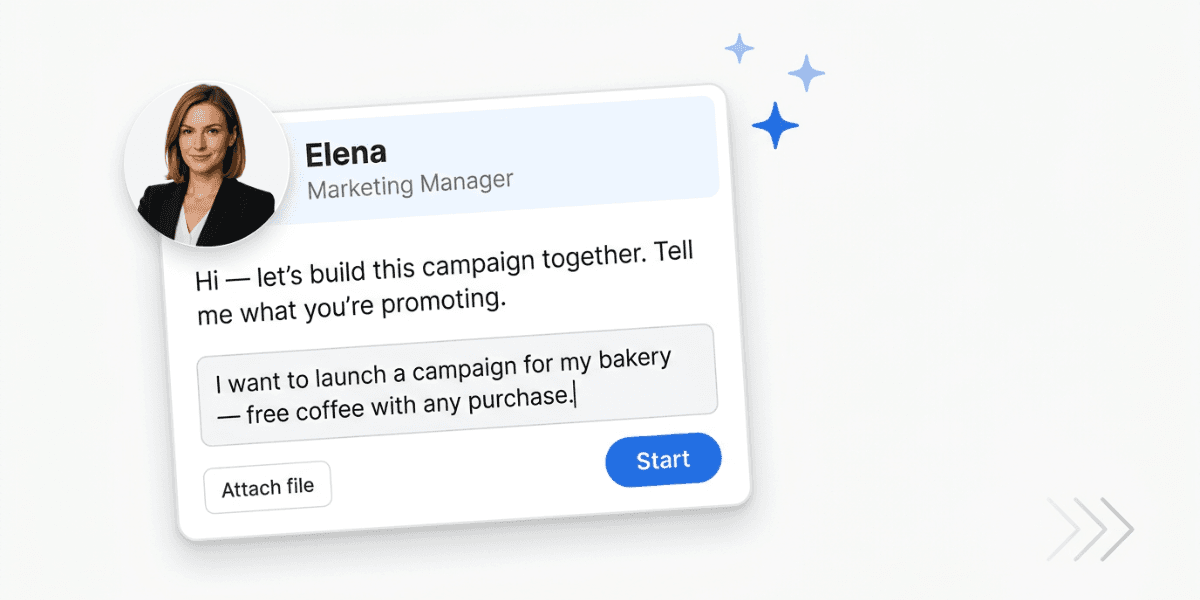
You start one of two ways. Either you talk through the campaign with the team manager — "we have a webinar in three weeks, want to drive registrations" — or you hand over a document and let the team extract what it needs. In Friday Force, you're talking to Elena, the team's marketing manager. The document can be an event flyer, a product one-pager, a promo PDF, or an internal brief.
The document path is the underrated one. Most marketing teams already have artifacts: the flyer the events team made, the announcement the product team drafted, the slide the founder put together. Feeding those in directly saves the brief-rewriting tax that usually swallows the first hour of any campaign. (If you don't have a brief at all, our guide to building a simple marketing plan with AI walks through the inputs that matter.)
Phase 2: Clarifying questions
This is the phase that separates real campaign agents from glorified content generators. The agent should not produce a campaign from a partial brief. It should surface what's missing and ask.
Common gaps: What's the registration link? What action do you want a viewer to take? What's the deadline? Is there an offer? Who's the audience? An agent that confidently guesses at these will produce confidently wrong work. (Audience is the gap that quietly costs the most — our piece on AI target audience research covers how to actually nail this input.)
The hardest part of campaign management has never been creation. It's the brief. Teams that produce mediocre campaigns are usually doing so because the brief was vague, not because the writers were bad. Holding the line on brief completeness is one of the highest-leverage things an AI marketing agent can do, and one of the most common places they fall short.
Phase 3: The campaign plan
Once the agent has enough, it produces a plan. This is the artifact you actually review. A real plan specifies:
- Which platforms the campaign will run on, and why each
- What the campaign will say on each platform, varied for that surface
- When each piece publishes, sequenced toward the campaign goal
A vague theme isn't a plan. "Pre-event awareness phase" isn't a plan. A plan is "Wednesday April 9, Instagram carousel, three slides previewing speaker bios; Friday April 11, blog post on the technical track; Monday April 14, LinkedIn post with registration link." If your agent's output looks more like a vibe board than a content calendar, it isn't running campaigns yet.
Phase 4: Execution
When the plan is approved, execution moves to the specialist roles. In Friday Force this is the moment Elena hands off to the rest of the team — Omar, Jasmine, Priya, and Luis — who work in parallel rather than in handoff queues. Strategy refines for each piece. Copy gets written. Visuals get designed. Schedules get mapped to specific days and times based on platform conventions and the campaign arc.
The coordination behind this — handing the right context to the right role at the right moment, keeping the campaign coherent across pieces — is the part platforms exist to solve. Marketing teams shouldn't have to manage that themselves. Done well, it's the difference between multi-channel automation that scales and one more dashboard to babysit.
Phase 5: The review surface
Every piece of output collects in one view: copy, visual, channel, and timing for each post. The reviewer can:
- Approve in bulk if the campaign holds together
- Approve post-by-post, editing captions, swapping visuals, shifting times
- Send specific pieces back for revision
This phase is where most platforms diverge from each other. Some force per-asset review. Some bulk-approve everything by default. Some show the campaign as a calendar; others as a list. The right surface depends on how much oversight you actually want — which is itself a function of brand sensitivity and campaign stakes.
Phase 6: Scheduling
Confirmation is the moment of scheduling. The platform pushes the approved posts to the publishing surfaces — Instagram, Facebook, LinkedIn, the blog CMS — at the times mapped in the plan. No copy-pasting captions into Meta Business Suite. No reminders to push the next post.
The full loop, brief to scheduled, runs in a fraction of the time it takes a traditional team-based workflow. The headline metric most platforms cite is days-to-launch, but the more useful one is reviewer-hours-per-campaign — that's where the actual savings show up for small teams. (And once campaigns are live, what gets measured matters as much as what gets shipped — see our breakdown of the essential marketing metrics worth tracking.)
What this changes about how marketing teams work
The role shift is the part most worth thinking about. When campaign execution compresses from days to hours, the marketing manager's job changes from production to direction. Less time in Canva and Buffer. More time on what the campaign is trying to do, who it's for, and whether the work is on-brand.
This is a real benefit for small teams and founders running their own marketing. A two-person team can run a cadence that previously required an agency. The trade is that the team has to be sharper on inputs — strategy, brand voice, audience clarity — because the system will execute against whatever brief it's given. Bad strategy now scales faster.
For larger teams, the change is less dramatic. Most enterprise marketing departments will still have humans doing the strategy and creative direction the agents can't, with agents replacing the production layer underneath. The shape of the team changes more than the size of it.
Where the category still falls short
A balanced view: most coverage of agentic marketing oversells what every platform delivers. Here's where the category actually has gaps — and where the better-built platforms are pulling ahead.
Brief interrogation is rare. Most platforms generate from whatever brief they're given. If the brief is vague, the campaign is vague. The platforms pulling ahead are the ones whose manager interrogates the brief before executing — surfacing missing CTAs, unclear timelines, undefined audiences. The hardest part of campaign management has always been the brief, not the production. Platforms that solve the brief problem produce noticeably better work.
Brand voice fragmentation. Generated copy drifts when there's no shared brand system feeding every specialist. Without a structured brand kit (voice, tone, do's and don'ts) and without campaign-level context passed between roles, output across a multi-post campaign starts to read like it came from different writers. Platforms that pass a consistent brand system to every specialist mitigate this; the ones treating each generation as a one-shot don't.
Edge cases need humans. Crisis communications, regulatory announcements, partnership reveals, anything legally sensitive — keep humans in the driver's seat regardless of platform. The cost of a wrong post on a sensitive topic outweighs any speed benefit. Most serious platforms support campaign-type guardrails for exactly this reason.
Integration boundaries are where time savings disappear. A common gap: the platform generates everything but hands you back to manual work at the publishing layer. You still copy-paste captions into Meta Business Suite, re-upload visuals, set scheduling reminders. Real campaign-running platforms publish natively. The handoff at the integration boundary is where most of the promised time savings disappear.
Review fatigue is the new bottleneck. When generation is cheap, the rate-limiting step moves to evaluation. Teams that adopt these platforms without rethinking review workflows end up with backlogs of unapproved content. The platforms that handle this well give reviewers efficient surfaces — bulk actions, scoped approvals, role-based sign-off. The ones that don't simply move the bottleneck.
The trajectory the category is heading toward — and the right one — is greater autonomy with stronger safety. Not absent humans, but humans focused on the decisions that need them. Today's review-heavy workflows are scaffolding, not the end state. The platforms making serious progress toward that future are the ones investing in brand systems, approval guardrails, and reliability now, rather than promising hands-off marketing tomorrow.
How to evaluate AI marketing agents for your team
Pricing is not the right first filter. Workflow fit is. The questions that actually predict whether a platform will work for you:
- Does it have specialist roles with their own area of expertise, or is it one AI in different costumes? Test by comparing the strategist's output to the copywriter's output. If they read the same, they are the same.
- Does it ask clarifying questions, or guess? Hand it a deliberately incomplete brief and see what happens.
- Does it handle the full workflow, or hand off at the messy parts? Watch where the platform hands you back to manual work.
- Where does the human stay in the loop? You want defined approval gates, not optional ones.
- How does it handle brand voice at scale? Ask to see the same campaign for two different brand profiles. The differences should be substantial.
- What does the review surface look like? Plan to spend most of your time there. If it's painful, the platform won't stick.
Run a real campaign through any platform you're seriously considering. Demos are uniformly polished. Real campaigns expose the gaps. (If you're cross-shopping social-first tools specifically, our Hootsuite alternatives breakdown takes the same evaluation lens to that category.)
Frequently asked questions
What's the difference between an AI marketing tool and an AI marketing agent?
A tool produces an output when prompted and stops. An agent takes a goal, plans the steps to reach it, and executes across multiple actions and tools without a prompt for each step. A copywriting tool generates a caption when you ask. An agent plans a campaign, writes the captions, designs the visuals, schedules them, and reports back.
What's the difference between an AI marketing agent and an AI Marketing Team?
A single AI marketing agent is one role doing one job — write the copy, generate the image, schedule the post. An AI Marketing Team is a coordinated set of specialist roles working together, with a manager role orchestrating them: a strategist, copywriter, designer, social media manager, analyst, all sharing context. The team framing better matches how marketing actually works in real organizations and produces more cohesive campaigns than any single agent can.
Can an AI marketing agent replace a marketing manager?
Not for the work that matters. AI agents handle execution well — production, sequencing, scheduling, basic optimization. They do not replace strategy, brand judgment, creative direction, or the editorial decisions a senior marketer makes. Most teams using agents see the manager role shift toward direction and review rather than disappear.
How do AI marketing agents handle approvals and brand consistency?
Through a combination of brand context (style guides, tone rules, prior content), structured review surfaces (per-post or bulk approval before publication), and platform-specific guardrails. Consistency improves with more brand context but does not become automatic. Most teams maintain editorial review on owned content even after adoption.
What kinds of campaigns can AI agents run?
Anything with a defined goal and timeline. Events and webinars, product launches, promotions and sales, content series, customer story sequences, seasonal campaigns. Where they perform best is high-volume, repeatable campaign types. Where they struggle is one-off, brand-defining moments where strategy and creative judgment matter more than throughput.
Do you still need human marketers?
Yes — but the work shifts. Less production, more direction. Less assembly, more strategy. The teams getting the most out of these platforms are the ones treating the agent as a junior team that needs clear briefs, not as a replacement for thinking.